Learning To Trust Yourself More Than Other People’s Opinions

What happens when you stop waiting for permission
and start building a life that feels like your own.
One of the hardest things I’ve been learning lately is how to trust myself more than I trust other people’s opinions.
That sounds simple when I write it out, but it’s been a much bigger process than I expected.
For a long time, I looked to other people for confirmation that I was on the right path. I wanted support. I wanted encouragement. I wanted people to understand what I was trying to build and why it mattered to me. When people seemed excited about my ideas, I felt more confident. When people seemed doubtful, I doubted myself too.
Looking back, I can see how many times I abandoned things that genuinely mattered to me because I didn’t receive the support I was hoping for. Not because the idea was wrong. Not because I wasn’t capable. Not because it couldn’t work. I simply didn’t believe in myself enough to continue without outside validation.
Lately, that’s been changing.
I’ve been realizing that most people can only give advice from the perspective of their own experiences. The person who values security may not understand why you’d take a risk. The person who has never built a business may not understand why you’d pursue something uncertain. The person who has never felt called toward a creative path may not understand why you’d keep creating when there are no guarantees.
That doesn’t make them bad people. It doesn’t mean they’re trying to hold you back. Most of the time, they genuinely want the best for you.
The problem happens when we start treating their perspective as more trustworthy than our own.
I think many of us do this without realizing it. We become so focused on whether other people approve of the choices that we stop listening to ourselves. We ask everyone else what they think before asking ourselves what feels true. We become disconnected from our own intuition because we’re constantly looking outward for answers.
Eventually, that becomes a form of self-abandonment.
I’ve noticed this showing up in my business, my content, and the way I move through the world. People often have opinions about what I should be doing. They have opinions about what kind of content I should make, what kind of work I should pursue, what is realistic, and what isn’t.
Some of that feedback is helpful. Some of it isn’t.
What I’m learning is that I don’t have to follow every suggestion simply because it came from someone who cares about me. I can appreciate their perspective while still choosing my own path.
For the first time in a long time, I feel like I’m building something because it matters to me, not because I think it will impress someone else. I’m talking about subjects that genuinely light me up. I’m creating things that I wish existed when I needed them. I’m pursuing ideas that feel aligned even when I don’t know exactly where they’ll lead.
There are still moments where criticism stings. There are still moments where rejection hurts. There are still moments when I wonder whether I’m making a mistake.
The difference is that those moments are no longer making my decisions for me.
I think one of the biggest misconceptions about confidence is that confident people don’t experience doubt. They do. The difference is that they don’t let doubt become the driver. Confidence isn’t believing you’ll never fail. Confidence is trusting yourself enough to continue even when you don’t know how everything will unfold. That’s where I find myself right now.
I’m learning to trust that the people who are meant to resonate with what I’m creating may not even know I exist yet. I’m learning to trust that not everyone has to understand my vision for it to be valid. Most importantly, I’m learning to trust that I don’t need permission to build a life that feels meaningful to me.
If you’re in a season where you’re choosing yourself, betting on yourself, or creating something that other people don’t fully understand, I hope you know you’re not alone.
The small steps matter. The invisible work matters. The days when you keep showing up despite uncertainty matter.
A seed doesn’t become a tree overnight. Growth is happening long before there’s visible proof. The roots are forming beneath the surface before anyone can see what’s coming. Keep watering the seed anyway. Trust yourself anyway. Keep going anyway.
If this topic resonates with you, I created a free resource called the Emotional Safe Love Guide. While it focuses on relationships, the deeper theme is learning to recognize where we abandon ourselves and what emotional safety actually feels like. Many of the patterns we experience in romantic relationships also show up in friendships, family dynamics, business partnerships, and even in our relationship with ourselves.
Inside the guide, I cover signs of emotional safety, signs of self-abandonment, chaotic chemistry versus genuine connection, and journal prompts to help you reconnect with your own truth and intuition.
You can download it completely free and keep it as a resource whenever you need a reminder that healthy love—whether romantic, platonic, or internal—should never require you to abandon yourself to receive it.
To get your free guide, click the link below.
With love,
Paige
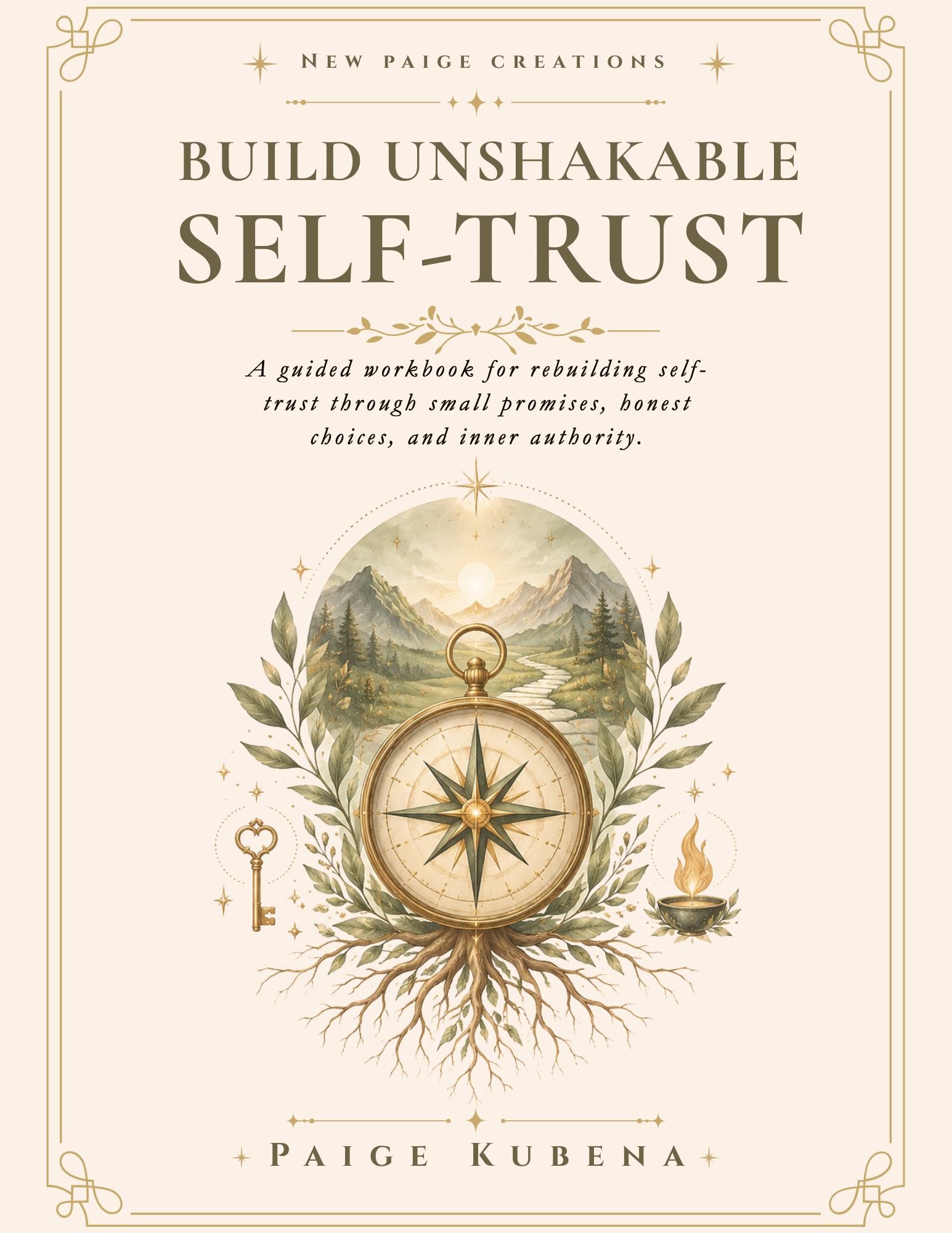
Do you ever find yourself overthinking decisions, replaying conversations, or looking to other people for answers you wish you could confidently give yourself?
Maybe you know what you want, but you second-guess it. Maybe you ask for advice, receive five different opinions, and somehow feel even more confused than when you started. Maybe you're tired of questioning yourself every time life asks you to make a decision.
The truth is that confidence isn't usually the problem. Trust is.
When you trust yourself, you don't need to have all the answers. You don't need certainty before taking action. You don't need to know exactly how everything will unfold. You trust that you'll be able to handle whatever happens next.
Build Unbreakable Self-Trust is a guided workbook designed to help you strengthen your relationship with yourself, rebuild confidence in your own judgment, and stop treating every mistake as evidence that you're failing.
Inside, you'll explore:
• What self-trust actually is (and what it isn't)
• How self-trust gets broken over time
• The difference between fear, anxiety, and intuition
• How to build evidence that you can rely on yourself
• How to navigate mistakes without losing confidence in yourself
Through thoughtful reflection prompts, practical exercises, and guided journaling, you'll begin creating the one thing self-trust is built on: evidence.
Because self-trust isn't believing you'll always get it right. It's knowing that even when life doesn't go according to plan, you'll still have your own back.
Digital Download • Instant Access
